

Concentric vs. Eccentric Reducers: How to Prevent Cavitation in Pump Suction Lines
In industrial piping systems, selecting the wrong pipe fitting at a pump inlet can lead to severe mechanical failure, costly downtime, and premature equipment wear. One of the most common—and preventable—causes of pump damage is cavitation triggered by improper reducer selection or installation.
When transitioning from a larger suction header to a smaller pump nozzle, piping engineers must choose between two primary butt weld reducers: concentric reducers and eccentric reducers. Understanding the fluid dynamics behind both fittings is critical to maintaining Net Positive Suction Head Available (\(NPSH_{A}\)) and protecting centrifugal pumps.
Quick Answer: Which Reducer Should You Use on a Pump Suction Line?
For horizontal pump suction lines, you must always use an eccentric reducer installed with the flat side on top (Flat-Side-Up / FST).
Using a concentric reducer—or installing an eccentric reducer with the flat side on the bottom—creates a high point where trapped air and vapor accumulate. When those vapor pockets enter the pump impeller, they violently collapse, causing destructive cavitation.
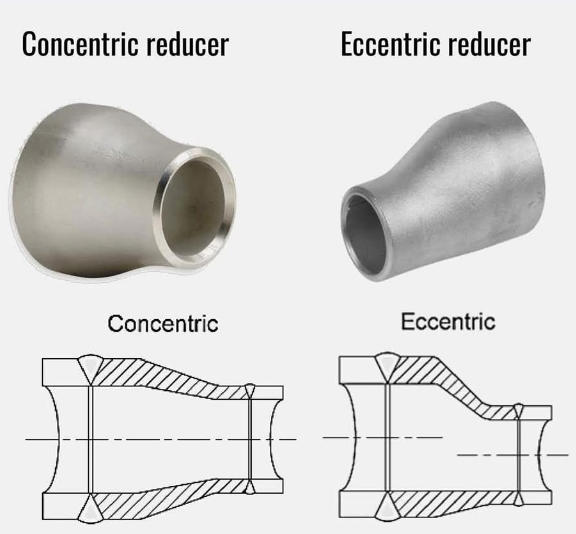
Understanding Concentric vs. Eccentric Reducers
Both concentric and eccentric reducers manufactured to ASME B16.9 standards connect pipes of different diameters, but their centerlines and flow profiles differ significantly.
| Feature | Concentric Reducer | Eccentric Reducer |
| Geometry | Symmetrical cone shape; both ends share a common centerline. | Asymmetrical offset; centerlines of the large and small ends are offset. |
| Flow Profile | Uniformly narrows flow around the central axis. | Keeps one side of the pipe wall completely flat/level. |
| Primary Application | Vertical piping lines, pump discharge lines, and gas/vapor piping. | Horizontal liquid piping, pump suction lines, and pipe racks. |
| Air/Vapor Risk | High risk of trapping air pockets at the top crown in horizontal runs. | Eliminates high-point air traps when installed flat-side-up. |
1. Concentric Reducers
A concentric reducer tapers uniformly from the larger diameter to the smaller diameter, maintaining a shared centerline. Because of its symmetrical design, it is ideal for vertical pipelines and pump discharge lines, where fluid pressure is high and air entrapment is not a concern. However, when placed horizontally on a suction line, the upper slope forms a pocket where dissolved gases separate from the liquid and collect.
2. Eccentric Reducers
An eccentric reducer features an offset centerline, creating one flat side and one sloped side. This geometry is engineered specifically for horizontal piping runs where elevation changes along the top or bottom of the pipe must be controlled.
How Improper Reducer Selection Causes Pump Cavitation
Cavitation occurs when the local static pressure of a liquid drops below its vapor pressure, forming vapor bubbles. As these bubbles move into higher-pressure zones inside the pump impeller, they implode with extreme force.
Here is how a concentric reducer on a horizontal suction line accelerates this failure:
- Air Pocket Formation: As liquid flows from the larger header into the tapering top section of a concentric reducer, a dead zone forms at the upper crown. Air and vapor accumulate here.
- Flow Restriction & Pressure Drop: As the air bubble grows, it restricts the cross-sectional flow area of the pipe, increasing fluid velocity and causing a localized pressure drop.
- Vapor Ingestion: Eventually, the fluid stream sweeps the large air pocket directly into the pump eye, causing air-binding, erratic flow, severe vibration, and impeller pitting.
Installation Best Practices: Flat-Side-Up vs. Flat-Side-Down
Simply specifying an eccentric reducer is not enough; orientation during welding is equally critical.
When to Install Flat-Side-Up (FSU)
- Standard Horizontal Pump Suction Lines: When the suction pipe approaches the pump horizontally—or drops down from an overhead pipe rack into the pump—install the eccentric reducer flat-side-up. This keeps the top of the pipe level, allowing any air bubbles to pass smoothly into the pump before they can accumulate into large, damaging pockets.
When to Install Flat-Side-Down (FSD)
- Bottom-Up Suction Lines (Coming from a Sump or Underground): If the suction pipe rises vertically from below and turns horizontally into the pump nozzle, an air pocket can form at the top of the elbow rather than the reducer. In specific cases where draining solids or preventing sediment buildup is the priority (or when specific piping layouts dictate), flat-side-down may be used to maintain a consistent bottom-of-pipe (BOP) elevation—commonly seen on pipe racks.
Engineering Tip: Always maintain a straight run of pipe (typically 3 to 5 pipe diameters) between the reducer and the pump suction flange to ensure laminar, uniform flow into the impeller.
Material & Standard Considerations for Critical Pump Systems
Selecting the right geometry only solves half the challenge; the fitting must also withstand system pressure, temperature, and media corrosiveness. High-integrity pump suction lines typically require seamless or welded reducers conforming to:
- Dimensional Standards: ASME B16.9, DIN 2616, EN 10253, or JIS B2311.
- Carbon Steel (ASTM A234 WPB / WPC): Ideal for general water, oil, and utility services.
- Stainless Steel (ASTM A403 WP304 / 316L): Essential for corrosive chemical processing, food/beverage, and pharmaceutical lines.
- Duplex & Alloy Steels (ASTM A815 / A234 WP11, WP22): Required for high-salinity desalination (RO) systems and high-temperature power generation boiler feed pumps.
Source Certified Butt Weld Reducers from Authentic
At Authentic Pipe Fittings, we manufacture precision-engineered concentric and eccentric reducers designed for zero-defect performance in demanding oil & gas, power generation, water treatment, and marine piping systems.
- Full Standards Compliance: Manufactured strictly to ASME B16.9, DIN, EN, and JIS specifications with smooth internal transitions to minimize turbulence and pressure drop.
- 40+ Global Certifications: Backed by ASME PP, API, PED, ABS, DNV, and ISO 9001 certifications.
- Complete Traceability: Every fitting ships with full EN 10204 3.1 Mill Test Certificates (MTC) and rigorous non-destructive testing (UT, RT, PMI).