

Understanding the Welding Principle of Butt Weld Pipe Fittings
In industrial piping systems governed by standards like ASME B16.9, butt weld fittings (such as elbows, tees, and reducers) are widely utilized for high-pressure and high-temperature applications. A common technical question among technicians is: What exact type of welding is implemented when we perform a "butt weld" on these fittings?
1. The Joint Configuration: Butt Joint
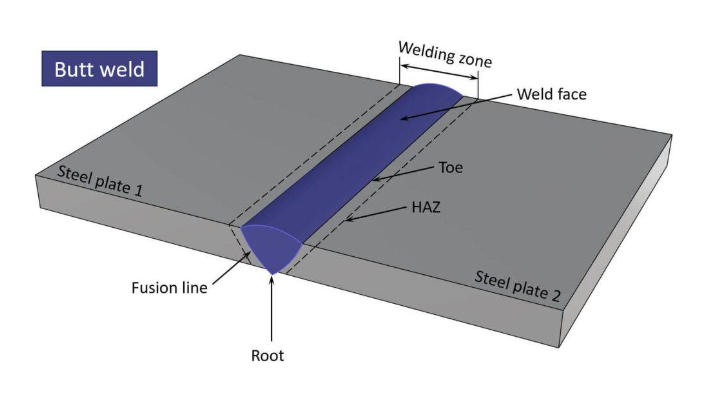
From a geometric standpoint, the "butt" in butt welding refers to the Butt Joint. This configuration involves placing the beveled end of the pipe fitting directly face-to-face (edge-to-edge) with the matching beveled end of the process pipe. Unlike socket weld fittings where the pipe slips into a recessed socket, a butt weld joint forms a single continuous, coplanar metal boundary.
2. The Weld Type: Groove Weld & Full Penetration
The resulting weld is a Groove Weld requiring Complete Joint Penetration (CJP). The weld metal fuses through the entire pipe wall thickness, eliminating internal crevices or flow restrictions.
3. Industrial Welding Processes
Achieving a quality butt weld typically involves a multi-process approach:
- GTAW / TIG: Used for the root pass to ensure a clean, defect-free internal bead.
- SMAW / Stick or GMAW / MIG: Utilized for high-efficiency filling and capping passes.
Conclusion
In essence, a butt weld is a complete joint penetration groove weld applied to a butt joint. This geometry allows for volumetric non-destructive testing (such as Radiographic Testing/RT), making it ideal for critical piping systems.